
Source Feed: Regenerative Culture Chronicle
Published: 2025-07-26 15:10:26
Content Type ID: 3
Over 70% of the world’s soils are degraded. Global wildlife populations have dropped by 73% since 1970. Most people work in jobs that don’t nourish them or the planet. Regenerative Culture is a real strategy to rebuild systems so all life can thrive, not just survive.
Imagine a world where every action contributes to life’s flourishing, where human systems actively heal and restore the world. This is the profound promise of Regenerative Culture.
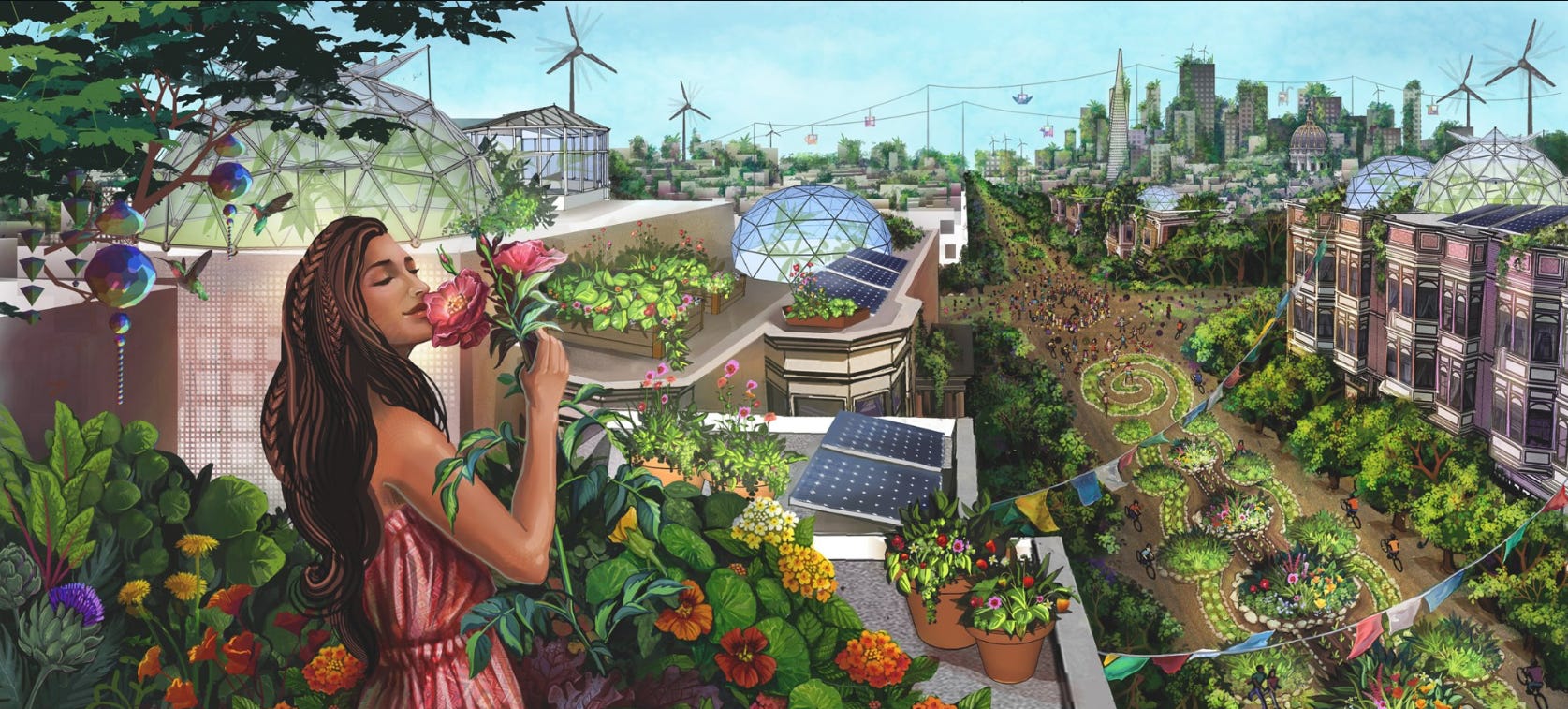
“Coherence from the imagination to the thought, to the word, to the action is how we create our reality…”
What is Regenerative Culture?
Yoshi Pantera (regenerativeculture.life)
“Regenerative Culture is the collection of human decisions and actions, thus habits, that cultivate harmony in the world, creating holistic systems that benefit all life.”
Daniel Christian Wahl (Designing Regenerative Cultures):
“A regenerative culture is one that is healthy, resilient, and adaptable; it cares for the planet and all its inhabitants, and it creates the conditions for life to continuously renew itself, to transcend into new forms, and to flourish.”
Carol Sanford (The Regenerative Business):
“Regeneration is the capacity to grow, evolve, and express unique potential in ways that contribute to the vitality of the whole.”
Framework:
Regenerative culture goes beyond sustainability by actively restoring and enhancing ecological, social, and spiritual systems. It’s about measurable net-positive impact, healing what’s broken, not just maintaining what’s left.
Check out my other article on What is Regenerative Culture?
A Note on Evidence & Emergence
Regenerative Culture is not a finished product or a proven formula. It’s an evolving way of life, a conscious experiment in reconnecting with all living systems as One. While large-scale, long-term evidence is still emerging, the logic is simple: the more we expand our consciousness, the more we recognize that thriving together is the only viable path forward.
At the end, there is no need to prove that regeneration works in order to accept it in our lives. It’s about choosing a direction that aligns with our deepest values and the needs of life in the planet. It’s being conscious about all life on it’s purest form. Regeneration is a mindset and a movement toward our next evolutionary step.
Unity in Diversity
In the regenerative movement, emerging over the past decade, Regenerative Leaders globally often approach its foundational pillars from diverse perspectives, each focusing on areas of societal improvement designed to benefit all life. While these specific focuses may differ, potentially leading to some initial confusion for newcomers, the regenerative movement is fundamentally united by one principle: creating new systems that enable all life forms – current and future generations – to thrive in health, abundance, and prosperity. Therefore, we honor and respect all perspectives within this movement, promoting new ways to communicate and collaborate rather than falling into the old trap of competition.
To create this new, regenerative world, we must observe and understand all aspects of human society. Our aim is to address all human needs in a way that simultaneously regenerates the world, benefiting all life.
Personal Coherence First
Furthermore, for true coherence, we cannot regenerate the world without regenerating ourselves first. In other words, one cannot genuinely advocate for Regenerative Business, Regenerative Technology, or a Regenerative Economy without personally embodying a Regenerative Lifestyle. You don’t have be perfect and live 100% in regeneration, but to be coherent enough and committed to improvement is essential to become a Regenerative Leader, an inspiring example for others to learn from and collaborate with across any regenerative pillar or area of the movement. This personal alignment ensures authenticity and provides the deep understanding necessary for external change.
From Personal Practice to Planetary Shift
Once you establish a Regenerative Living rhythm and embrace your role as a Regenerative Leader, you can engage other pillars and lead projects with confidence and clarity, or join other leaders and initiatives already doing great work.
With that said, and knowing your interest in this topic, I share your desire to witness a beautiful world in our lifetime. A world where all life thrives to its fullest potential, founded on love, health, and peace, free from the degenerative, controlling old systems that have depleted our planet and spirit. Therefore, our cultures – our very habits – need to change, to regenerate. Once a critical big number of us humans embody regenerative ethics and principles in our daily lives, we can then expand our efforts to act on a large scale within the Regenerative Pillars.
Regeneration isn’t just a personal lifestyle or a policy goal, it’s a pattern that scales. Every action, from the way you start your morning to all decisions and actions you make, ripples outward and contributes to either degeneration, or regeneration.
Before we dive into the 8 pillars, here’s a simple example of how regenerative culture unfolds from the individual to the planetary:
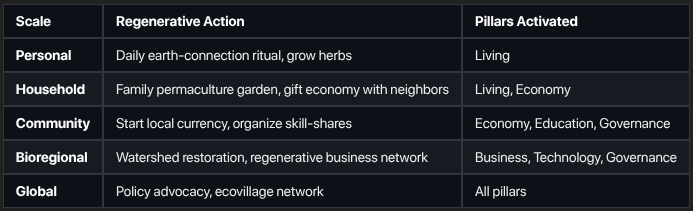
Note: Each level builds on the last. Personal practice = credibility. Community = proof of concept. Bioregional = systems change. Global = movement.
“We cannot regenerate the world, without regenerating ourselves first…”
Regenerative Culture Pillars
Below you will find the 8 pillars of Regenerative Culture that I have put together in 2014, and just updated it for 2025. We will dive deep within the 8 pillars that include a brief description of each one. In a near future, I will post an article for each pillar separately to go even deeper.
List of 8 Pillars:
– Regenerative Living
– Regenerative Education
– Regenerative Economy
– Regenerative Business
– Regenerative Governance
– Regenerative Technology
– Regenerative Arts & Music
– Regenerative Spirituality
At the end of this article, I invite you to choose which of the 8 pillars do you enjoy reading the most and want to learn more about. All these principles are interconnected, so as you learn one of them, you will learn a portion from the others as well.
1. Regenerative Living
Living in harmony with nature, prioritizing well-being, circular resource use, and conscious daily choices that regenerates thy-self, communities and local ecosystems.
Regenerative Living is about re-evaluating one’s life, to deprogram and reprogram habits that benefit the self and all life. This means that you can picture-imagine the best lifestyle you can ever dream of. Where your better version of you is in full activation, living in your beautiful off-grid home in an eco-neighborhood or ecovillage, surrounded by paradise: mountains, river, ocean. You name it. You are the creator. All this is possible, you may have already started this path or you are already living it. That’s amazing.
Now, you want to recognize further that you are living a regenerative lifestyle, or want to know what it takes to achieve it. This means focusing on:
PERSONAL HEALTH: Nutritional eating, meditation, breathwork, exercise, martial arts, qigong, yoga, mindfulness, sacred sexuality. All these practices are examples, you don’t have to practice them all. The main focus is that you align your body, mind, and spirit with natural rhythms and cycles of life in order to optimize your personal health and your relationship with all life.
COMMUNITY: Building relationships based on mutual aid, gift economy principles, and collaborative decision-making that strengthens social structure.
ENVIRONMENT: Creating living spaces that work with nature, not against it. This includes permaculture systems with gardens, renewable energy systems, natural building materials, and zero-waste practices.
Practicing a Regenerative Lifestyle means that every decision and action that you take is coherent to contributing to these three aspects mentioned: Personal Health, Community and Environment.
Examples:
-
Applying a healthy lifestyle from the moment you wake up to the moment you go to sleep. From morning ritual, the food you eat and the waste you don’t create.
-
Growing your own food using permaculture principles while composting all organic waste
-
Buying whats needed from local farmers and producers to cover your needs, thus creating a local circular economy.
-
Living in a natural built home powered by renewable energy with rainwater harvesting systems
-
Participating in community land trusts or intentional communities like ecovillages
-
Practicing as best as possible the the rest of Regenerative Culture Pillars in your life, your community and business projects.
2. Regenerative Education
Learning that nurtures curiosity, critical thinking, creativity and holistic inner-standing, empowering individuals to co-create thriving – resilient futures.
Regenerative Education breaks free from the industrial model of schooling that treats students like products on an assembly line to serve as slaves to the conventional industrial system, which started about 200 years ago, named Prussian model or Factory education. Being completely outdated.
Instead, Regenerative Education honors each learner as a unique being with innate wisdom and gifts to offer the world. This approach integrates indigenous wisdom, ecological literacy, emotional intelligence, and practical life skills.
The focus shifts from memorizing information to developing systems thinking, creative problem-solving, and collaborative leadership. Students learn through direct experience with nature, community projects, and real-world challenges. They understand their role as stewards of the Earth and active participants in creating regenerative cultures.
Core Common Elements:
Just to name of few of the common elements of alternative and new educations pedadogies that exist, are:
1. Learner-Centeredness
-
All approaches prioritize the needs, interests, and active participation of the learner rather than a teacher-centered, one-size-fits-all model.
-
They encourage students to take ownership and agency over their learning journey.
2. Emphasis on Creativity and Critical Thinking
-
These methodologies foster creativity, problem-solving, and critical thinking rather than rote memorization or passive absorption of facts.
-
Students are encouraged to explore ideas, ask questions, and engage deeply with content.
3. Flexible and Personalized Learning Paths
-
Whether through self-directed learning, individualized AI personalization, or mixed-age classrooms, these approaches adapt curricula and pacing to each learner’s unique needs, preferences, and abilities.
-
Flexibility in when, where, and how learning occurs is a key feature.
4. Real-World Relevance and Application
-
Learning is connected to real-world problems, community issues, or meaningful projects, making education authentic and purposeful.
-
This relevance prepares learners not just academically but as active contributors to society.
5. Collaborative and Social Learning
-
Most emphasize collaboration, peer learning, and development of social skills alongside academic growth.
-
Democratic classrooms, Sudbury, and project-based learning highlight the importance of community and shared decision-making.
6. Teacher/Facilitator as Guide, Not Sole Authority
-
Educators act as mentors, coaches, or facilitators, supporting learners’ interests, encouraging inquiry, and guiding them rather than delivering top-down instruction.
Examples:
-
Classical Progressive Pedagogies
1. Montessori Education
2. Waldorf Education
3. Reggio Emilia ApproachStudent-Centered & Self-Directed Learning
1. Unschooling
2. Project-Based Learning (PBL)
3. Self-Directed Learning Centers / MicroschoolsDemocratic & Freedom-Based Education
1. Sudbury Schools
2. Democratic Classrooms
3. Summerhill School (A.S. Neill)Technology-Enhanced and Blended Learning
1. Blended Learning (mix of online and face-to-face)
2. AI-Personalized Learning
3. Virtual and Augmented Reality Learning
3. Regenerative Economy
An economic system designed to circulate value, regenerate natural and social capital, and prioritize long-term planetary health and prosperity over short-term profit.
Regenerative Economy values relationships and our individual frequency state instead of just money, personal data and attention.
The current extractive economy is degenerating life on the planet, our culture and communities. Regenerative Economy flips this script entirely. Instead of extracting value from people and nature, it creates systems that give back more than they take. Money becomes a tool for healing rather than exploitation.
This means moving beyond sustainability (doing less harm) to regeneration (actively restoring and enhancing life). We’re talking about economic models that strengthen communities, restore ecosystems, and create abundance for all beings, not just the wealthy few. We aim for all life to thrive in it’s natural state.
Key Principles:
-
Circular flows where waste becomes input for other processes
-
Local resilience through bioregional economies and community currencies
-
Cooperative ownership models that distribute wealth and decision-making power
-
Gift economy practices that honor reciprocity and mutual aid
-
True cost accounting that includes environmental and social impacts
Some Examples:
-
Community-supported agriculture (CSA) where consumers invest directly in local farmers
-
Local economic system, where the local community produces and consumes from each other their basic needs. From clothing, hygiene products, clothing, toys, furniture -to- technology, mechanic service and education tutoring.
-
Time banks where people exchange services using time as currency rather than money
-
Regenerative investment funds that only support businesses creating positive environmental and social impact
-
Creating a social coin, an independent community coin based on trust, like Muyu coin in Ecuador with 140 members exchanging good and services since 2020.
-
Modern Tech economic systems using Crypto, DAO and Refi.
4. Regenerative Business
Enterprises that create net-positive impact, integrating regenerative ethics and principles for conscious ecology and community into every decision, including sourcing, production system, end product or service, and partnership.
Regenerative Business isn’t about making profit while doing some good on the side, it’s about making profit through doing good. These enterprises are designed from the ground up to heal people, communities, and ecosystems while generating sustainable livelihoods.
Every aspect of the business, from sourcing materials -to- employee well-being -to- waste management, is designed to regenerate life. Success is measured not just in financial returns, but in ecological restoration, community resilience, and human flourishing.
Traditionally, “business” has meant making money by cutting costs wherever possible, maximizing profit by minimizing investment, sometimes at the expense of employees’s well-being and product quality. Over time, this way of thinking affected customers as well through not receiving a quality product or service, but more importantly, customer have adopted subconsciously a belief. That buying the cheapest option is always the smartest move. Negotiating to cheapest possible. That is considered good business. The problem is, this mindset undervalues the real worth of products and services, which ends up hurting the economy as a whole because nothing is paid for at its true price.
Core Characteristics:
-
Purpose-driven mission that addresses real-world challenges
-
Stakeholder governance that includes employees, community, and environment in decision-making
-
Regenerative supply chains that support small-scale, ecological producers
-
Living wage practices that ensure all workers can thrive
-
Ecological design that mimics natural systems and creates positive environmental impact
Examples:
-
1. Rainbow Grocery Cooperative (San Francisco, CA)
A worker-owned cooperative supermarket founded in 1975, turning 50 years of age this August. Rainbow is committed to supporting local organic farmers and exceeding San Francisco’s environmental standards. The co-op is democratically run by its employees, who make collective decisions focused on sustainability, fair labor, and community health. Rainbow champions zero-waste practices, invests in green technologies (like energy-efficient refrigeration and daylight harvesting), and acts as a hub for information on healthy, regenerative living.
-
2. AbovePhone (Remote/USA-based)
AbovePhone is a privacy-focused tech company, a leading pioneer regenerative technology. While primarily recognized for privacy, AbovePhone fosters responsible consumption and a long product lifecycle by promoting secure, open-source software and encouraging device longevity. They minimize radiation, promote ethical tech use, and design products to be healthy for users and less harmful to the planet, resisting built-in obsolescence, a rare regenerative philosophy in consumer tech.
-
3. Rio Muchacho Organic Farm (Canoa, Ecuador)
Rio Muchacho is a 10-hectare organic farm on Ecuador’s Pacific coast that has practiced regenerative agriculture, permaculture, and agroecology for 35 years. The farm demonstrates how tropical systems can restore degraded land through integrated approaches including agroforestry, natural composting, and biodiversity conservation. Currently being transformed into RAIZ Ecovillage -a regenerative sanctuary – Rio Muchacho continues evolving as a living laboratory where regenerative principles heal both land and community, proving that small-scale farms can create profound ecological and social impact.
-
Christy Dawn, a clothing business that goes beyond sustainability by partnering directly with small farms to grow cotton using regenerative agriculture. Their “Farm-to-Closet” initiative began with a plot of land in Erode, India, where, alongside the Oshadi Collective, they use practices like crop rotation, natural composting, and biodiversity support to heal the soil, capture carbon, and restore local ecosystems. The entire cotton supply chain, from farming -to- fabric, relies on these earth-restoring methods, supporting both environmental regeneration and local communities. In addition to the regenerative farm, Christy Dawn also uses deadstock materials (leftover fabric from larger fashion houses) to minimize waste.
5. Regenerative Governance
Decision-making rooted in transparency, inclusivity, and stewardship. Creating systems that serve the common good and future generations.
Current governance systems are failing us for generations. There is no trust and proof that it works where it actually benefits the people and surrounding environment. Regenerative Governance re-imagines how we make collective decisions, moving from domination hierarchies to collaborative networks that honor the wisdom of all voices, including future generations and all life in the world.
This approach draws from ancient wisdom practices, sociocracy, and biomimicry to create decision-making processes that are adaptive, inclusive, and life-serving. Power is distributed rather than concentrated, aka decentralized, and leadership rotates based on skills and passion rather than wealth or status.
Key Elements:
-
Consensus-building processes that seek solutions everyone can live with
-
Restorative justice approaches that heal rather than punish
-
Bioregional governance that aligns political boundaries with ecological watersheds
-
Youth and elder councils that ensure intergenerational wisdom guides decisions
-
Rights of nature legislation that honors and respects nature, giving legal standing to ecosystems.
Examples:
-
Transition Towns movement where communities democratically plan their shift to sustainability
-
Indigenous governance models like the Haudenosaunee (Iroquois) Great Law of Peace
-
Participatory budgeting where community members directly decide how public funds are spent
-
Ecovillages using sociocracy and consensus decision-making for community governance
6. Regenerative Technology
Innovations that heal, connect, and empower, designed to work with living systems and enhance the flourishing of all life.
Technology isn’t inherently good or evil, it’s a tool that reflects the consciousness of its creators. Regenerative Technology is designed with life-centered values, creating innovations that enhance rather than replace natural systems and human connection.
Instead of the current tech paradigm that extracts attention, data, and resources, regenerative technology gives back more than it takes. It’s purpose is to design for durability, repairability, and ecological integration rather than planned obsolescence and endless consumption.
Design Principles:
-
Biomimicry that learns from nature’s 3.8 billion years of Research and Development.
-
Open-source Collaboration that shares knowledge freely while creating relationships and empowering a community.
-
Appropriate Scale that matches technology to actual needs
-
Circular Design that eliminates waste and toxicity
-
Community Ownership of digital infrastructure and data
-
Respecting Privacy from all users and not sale data
-
Honoring Attention Use rather than making it addictive
-
Sourcing Material from ecological and ethical production companies
Examples:
-
Mycelium-based materials that can replace plastic and concrete while sequestering carbon
-
Mesh networks that create community-owned internet infrastructure
-
Precision fermentation that produces materials without industrial agriculture
-
Blockchain systems for transparent supply chains and community currencies
-
Bioremediation technologies that use plants and microorganisms to clean polluted environments
-
Decentralized / Peer -to- Peer apps for exchange of information, value, goods and services
7. Regenerative Arts & Music
Creative expression that inspires, heals, and reconnects us to ourselves, each other, and the living world, catalyzing cultural transformation.
Art has always been humanity’s way of making sense of the world and imagining new possibilities. Regenerative Arts & Music goes beyond entertainment, decoration, or money making machine. It becomes a catalyst for cultural healing and transformation. It helps us remember our connection to the Earth and each other while inspiring action toward regenerative futures.
It isn’t about preaching, propaganda, nor highlighting sexual pleasure any longer, but about touching hearts and opening minds through beauty, story, and shared transformational experience. Evolving the human consciousness. It’s about regenerating cultural values that can take root and flourish, giving fruits for future generations.
Forms of Expression:
-
Earth-based art using natural materials and honoring place
-
Community murals that tell stories of local resilience and vision
-
Ritual and ceremony that mark transitions and celebrate life cycles
-
Storytelling that shares wisdom and inspires possibility
-
Music and dance that builds community and expresses cultural values
Examples:
-
Alex Grey with his visionary art that helps expand consciousness just by looking at it
-
Bless, an artist from the Amazon in Ecuador, with his giant sculptures that work with natural processes, sculpting jungle animals and plants as a form of eco activism aka artivism
-
Porangui is a medicine musician creating collective musical experiences that actually heal.
-
Community choirs that sing for social justice and environmental causes
-
Indigenous artists preserving and sharing traditional ecological knowledge through art
-
Burning Man’s gift economy and collaborative art creation
-
Local music festivals that showcase regenerative businesses and practices
8. Regenerative Spirituality
Practices and worldviews that honor interconnection, sacredness, and the ongoing renewal of life, guiding us toward deeper purpose and belonging.
Regenerative Spirituality recognizes that our world crisis is fundamentally a spiritual crisis, a disconnection from the sacred nature of existence itself. It weaves together wisdom from indigenous traditions, contemplative practices, and direct experience of nature to cultivate a lived understanding of interconnection.
This isn’t about any particular religion or belief system, but about remembering our place in the quantum field of life and acting from that remembrance. It’s spirituality that doesn’t escape the world but engages more deeply with the healing of it.
Some Core Practices:
-
Earth-based rituals that honor seasonal cycles and natural rhythms
-
Contemplative practices like meditation, prayer, and mindful presence
-
Sacred activism that combines spiritual practice with social action
-
Ancestor reverence that honors those who came before and those yet to come
-
Ceremony and celebration that marks important transitions and achievements, while manifesting our desired collective reality.
Examples:
-
Indigenous guardians of nature combining prayer with direct action to defend and conserve sacred sites
-
Permaculture practitioners who begin each design with gratitude and intention-setting
-
Meditation communities that include environmental stewardship as spiritual practice
-
Seasonal celebrations that reconnect communities with natural cycles and local ecology
-
Birth and death doulas that honor life from beginning to end as a peaceful holistic awareness of our existence.
-
Ceremonies that bring community together in relationship with the land, the body and the cosmos.
-
Living a life of ceremony, honoring and respecting all life.
The Path Forward: A Living Evolution
Transitioning to a regenerative culture isn’t a quick fix or a single blueprint; it’s a dynamic, ongoing evolution. While the journey ahead is vast, it’s already unfolding through countless initiatives worldwide, from local food systems, healing degraded land -to- global networks, reimagining governance. This article offers the foundational pillars, but the deeper dive into how we collectively build this future, complete with actionable roadmaps and inspiring case studies, is a story best told in the upcoming series and the comprehensive book on Regenerative Culture. Stay tuned.
Love to all Life
These Regenerative Culture Pillars can only work if there is Love established as the main energy force that drives the movement to thrive. We use the following core forces that surround love.
-
Love the Self
-
Love the People
-
Love the Animals
-
Love the Planet
If love is not truly present within these 4 core Love Energy Forces, practicing the Regenerative Culture movement wont be coherent. The purpose of regeneration is for all life to thrive in peace and freedom.
Final Words
Personally, I am very grateful to be living during these times of global transformation. Humanity has been transforming over thousands of years, since the beginning, and during the past few decades there has been a major shift in consciousness, where people are taking responsibility to heal the self and be in service to the world.
One path is the regenerative movement, but there many ways to name the same purpose of transformation. Cultures and movements of peace, freedom, creativity, and health. We all want to co-exist in harmony.
Thank you
So thank you for choosing to be part of the movement and to take action with solutions to establish wealth, health and education for us and our future generations to prosper.
If you liked what you read, and you already apply some of what was mentioned into your life, congratulations!, as we are aligned in this journey together. Thus, we can continue walking the regenerative path as it is a never-ending growth of health and prosperity.
If you are new to the movement, you are right on time to start taking action and integrating these pillars into your life, community or business. Most of the world is in degenerative mode, but each day more of us our waking up to the collective power we all have to create our reality, where all living beings thrive.
If there is one or three pillars that interest you the most, and want to learn more about. Click below, choose your topics and subscribe to our email newsletter.
Regenerative Culture Retreat – SEEDS
If you are interested to radically accelerate the process of transitioning into a Regenerative Lifestyle and integrate the 8 Pillars you read today, plus 13 Regenerative Culture Principles, you are welcome to join our upcoming 11 Day Retreat happening August 20-30th in the Amazon Jungle of Ecuador.
Learn More
To learn more about the Regenerative Culture movement, below you can subscribe for FREE if you haven’t yet already. To support our work, you can upgrade here on Substack as a paid subscriber. Just $5 a month -or- $33 a year.
If you are already a free or paid Subscriber, thank you for being a member. Please note that after 2 weeks, every article published will have a paid wall. So make sure you read your articles within the time frame. For paid subscribers, this isn’t the case, you still have unlimited access until you decide to cancel. Thanks again for your support and interest in Regenerative Culture.
———
Thank you for reading
Yoshi Pantera


